Simple, yet decorative. Practical, while making a statement. That is the appeal of a Mid-Century Modern rope chair. Time and age can subject a rope chair to wear and tear, staining or even fraying the rope. This post is your guide for how to re-rope a Mid-Century Modern rope chair to restore it to its former glory.
A Brief History of the Mid-Century Modern Rope Chair
Let’s start with a little background. Mid-Century Modern rope chairs are elegant furnishings that unite the traditions of the past with a clean, modern look. The most famous designer of Mid-Century Modern rope chairs was Hans Wegner. He utilized the crafting technique of Danish Cord Weaving, building off of the works of early 20th century designers.
Some of Wegner’s famous rope chairs include the 1949 Wishbone Chair, and the 1950 Flag Halyard Chair. Rope weaving can be used to form the seat of a chair, the back of a chair, or both.
What Materials You Need to Re-Rope a Mid-Century Rope Chair
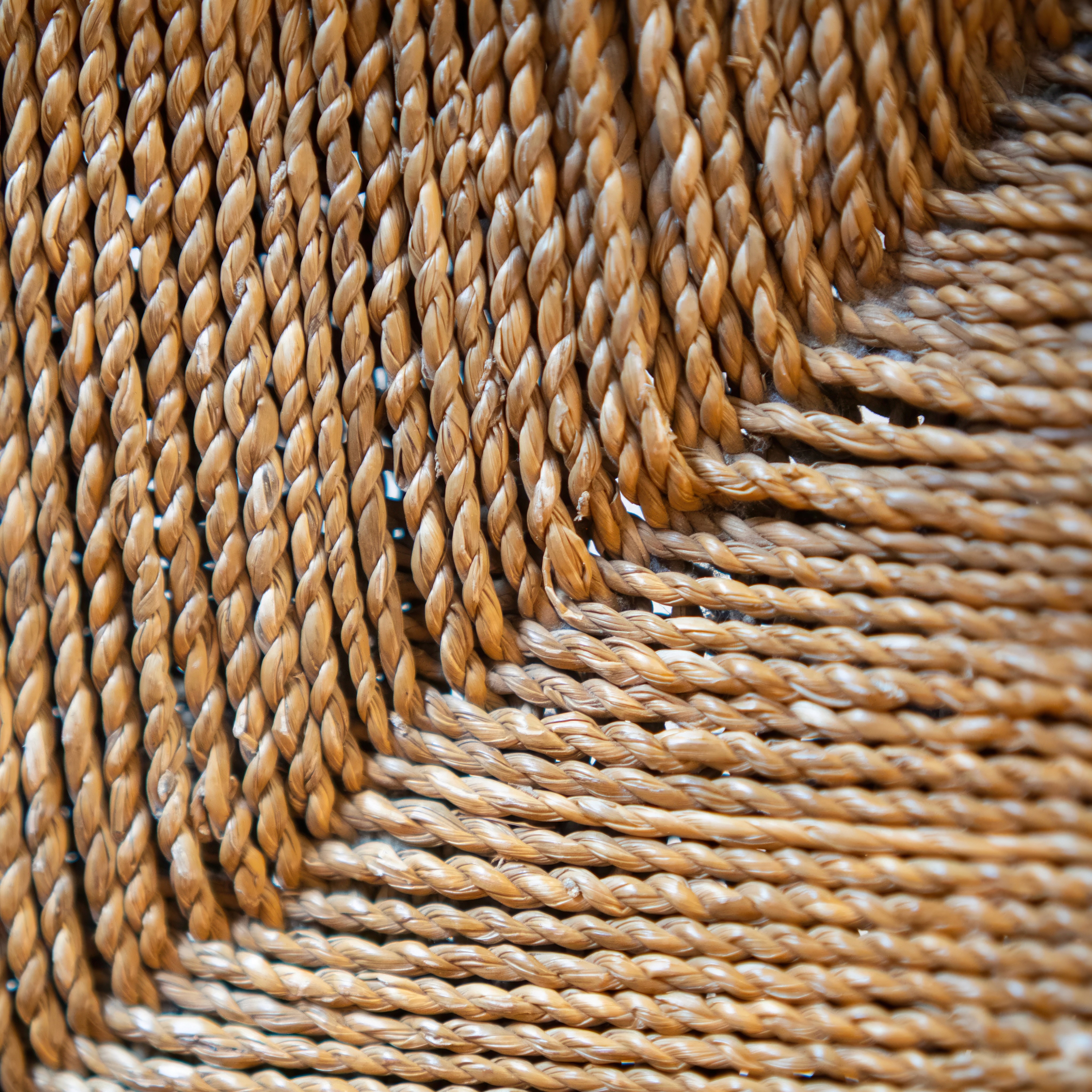
To re-rope a chair, you will want to try and match the original material used for your chair. The most common cord types for MCM chairs are laced (twisted) or unlaced (smooth) Danish cord.
Niels Otto Møller’s Model 71 is an example of a chair that features laced cord, while the Wishbone and Y-Chair are examples of chairs that feature unlaced cord. Make sure to also pick the right gauge (thickness) of rope.
It can be harder than you would think to identify the right type of cord. An experienced cord seller with knowledge of MCM rope chairs may be able to help you out.
Here is a list of the materials you will need to re-rope your chair:
The correct Danish cord for your chair
Lazy Susan-style turntable with a dowel
Upholstery tacks/nails
Wood glue (if you need to make repairs to the frame as well)
Clamps
Nitrile gloves
The purpose of the turntable with the dowel is to prevent your cord from tangling as you work.
The gloves are technically optional, but you’re definitely going to want them. The cord is dry and abrasive, and can rub your hands raw while you’re working. Nitrile gloves protect your hands from sores, while still letting you do fine, detailed work with ease.
How to Re-Rope a Mid Century Chair Step-by-Step
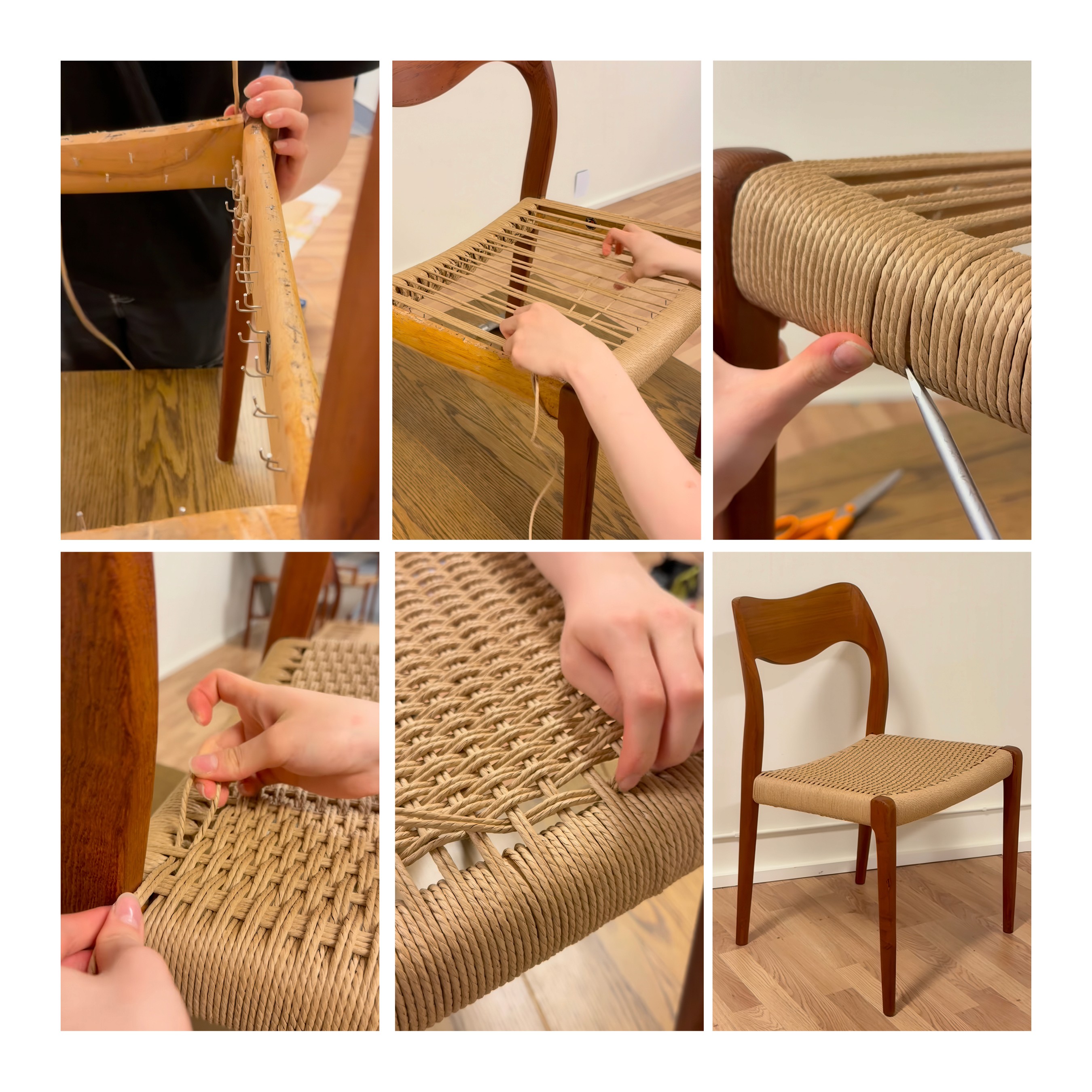
Below, we share the basic steps to re-rope an MCM chair. We will be focusing on the basketweave pattern, which was popular during the mid century era, and is pretty straightforward once you get the hang of it.
https://www.youtube.com/watch?v=3KoQJjU43SA&t=1s
1. Start by preparing the chair you are going to re-rope. Remove all the old rope and fasteners. This is a great time to clean the chair frame thoroughly.
As you are removing the old rope, pay careful attention to how it was woven, as well as where the rope was started. You are going to need to be able to replicate it. You do not have to un-weave it, you can just cut it away.
2. If the frame needs any repairs, now is the time to make them. Use the clamps and wood glue to address any weak or displaced frame joints.
3. Free up one end of the rope. Coil the rest of the rope around the dowel on the turntable.
4. Start the weave. Locate the correct starting point for the cord on the frame that you identified previously. Secure the end of the cord to the frame using a nail or staple (if you want to be as authentic as possible, try to choose the same method used originally).
5. Weave the warp. The “warp” is the cords that run vertically between the front and back of the chair, providing the structure you will be weaving through.
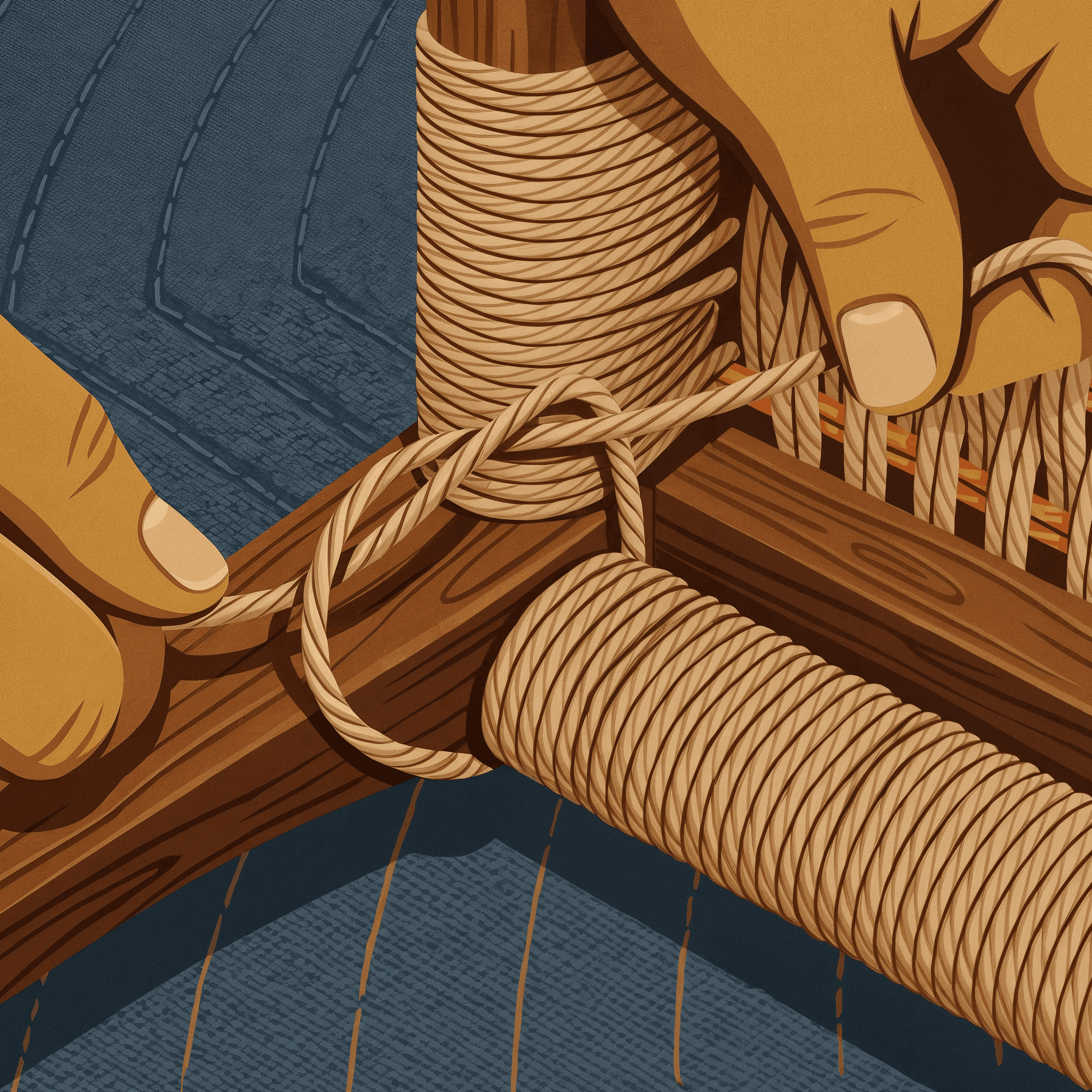
1. Loop the cord around the frame a number of times (the exact number depends on the specific chair you are re-roping and its original weave.
2. Pull the cord vertically across the top of the chair to the other side.
3. Wrap the cord around the frame on this side of the chair.
4. Make a little loop that you can pull the cord back through.
5. Pull the cord back across to the other side.
6. Continue going back and forth, repeating the pattern. You will end up with a series of vertical bands across the chair, which will make it look and function similar to a loom. The front and back sections of the wood frame will also be fully wrapped in cord.
As you work your way across the chair, adding vertical bands, keep pushing the cord looped around each section of the frame to the side, making it nice and tight and eliminating gaps.
6. Weave the weft. Now that the vertical warp is ready, you can start weaving the weft horizontally.
This process involves weaving the cords under the first vertical band, over the next one, under the one after that, over the next, and so on.
Pay close attention to the original weave. It is typical for it to be a pair of cords, rather than a single cord, that you are weaving horizontally.
Every time you reach one of the side rails, you will need to wrap the cords around the rail, and then go back in the other direction.
Remember to continue to tighten everything as you go so that there are no gaps, and the pattern is nice and even.
Another reason tightening the cord is important is because over time, it will loosen due to stretching. So, for it to maintain its shape, you need it to be quite tight to begin with.
7. Secure the end. The last step is to secure the end of the cord to the underside of the frame. You can do this using another nail or staple, as you did in the beginning.
We recommend that you see if there are any videos where someone works on your particular MCM rope chair, or at least a very similar one. Seeing someone actually weaving the correct pattern makes it much easier to understand what you are doing.
Where to Get Help Re-Roping Your MCM Rope Chair
Not sure you are up for learning how to weave a new seat for your rope chair? There are furniture repair companies that have experience with rope chairs, and which can handle the job of re-roping for you.
If possible, we recommend you go with a company that specializes in Mid Century Modern furniture repair and restoration. One example is Mod Restoration in New York. Re-cording and reweaving Danish corded chairs is one of their specialties. They are very familiar with the individual chairs and designers, materials, and techniques, making them experts at authentic, high-quality re-roping.

More Repair & Restoration